NCAA Eligibility Is Changing: What the New Age-Based Model Could Mean for College Athletes
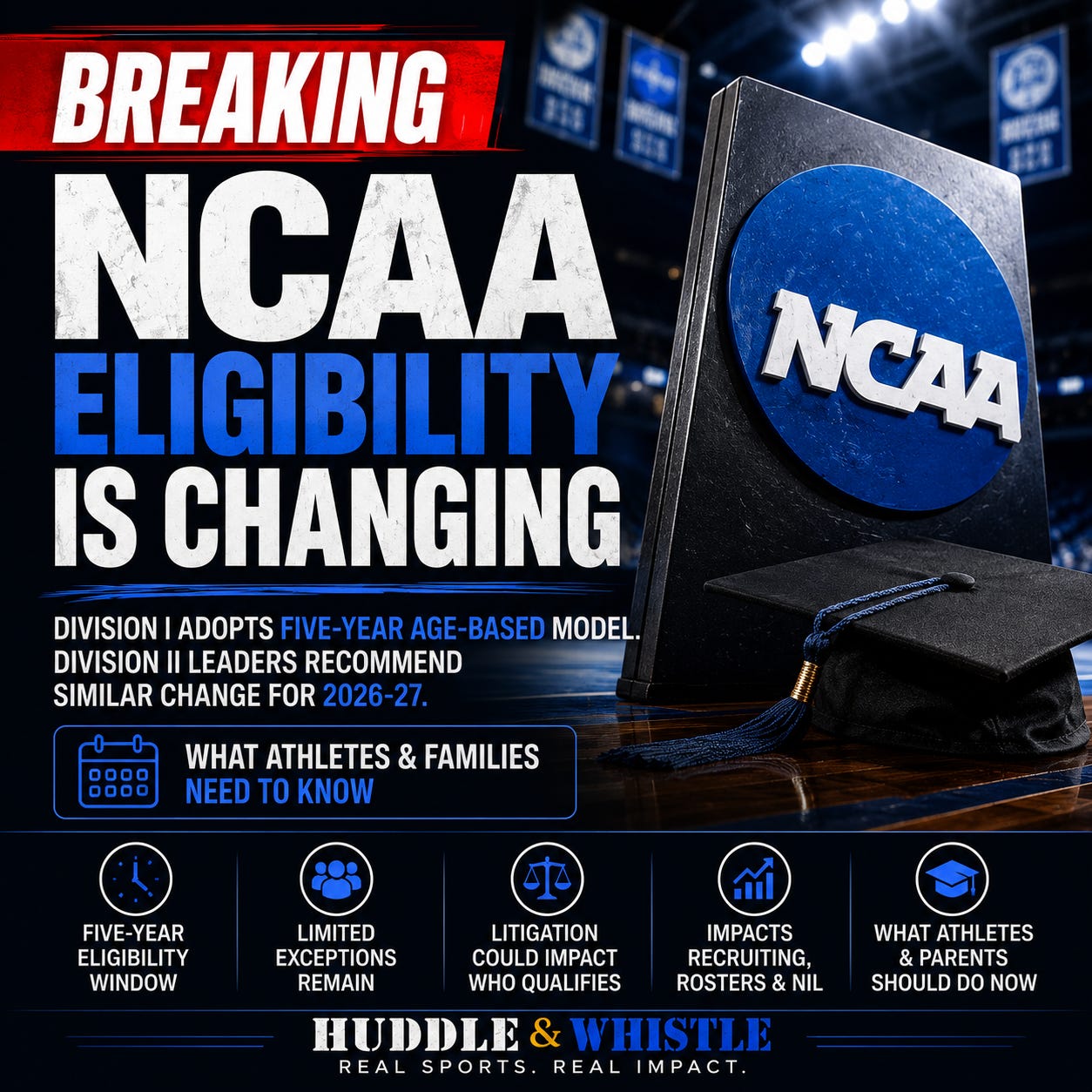
College athletes are entering a dramatically different eligibility era.
The NCAA Division I membership has adopted an age-based eligibility model that replaces the familiar system built around four seasons of competition, redshirts and numerous eligibility waivers with a continuous five-year eligibility period. The new Division I model takes effect August 1, 2026, with transition rules determining how it applies to current athletes and incoming students.
Division II may be headed in the same direction.
On July 21, the NCAA Division II Management Council recommended emergency legislation establishing an age-based five-year eligibility model for the 2026-27 academic year. Under the proposal, an athlete’s eligibility period would generally begin at initial full-time college enrollment or the regular academic year immediately following the athlete’s 19th birthday, whichever comes first.
The distinction is important: Division I has adopted its age-based model. The Division II Management Council has recommended a similar model.
Huddle & Whistle has not located a subsequent NCAA announcement confirming final adoption of the Division II recommendation by the Division II Executive Board.
That distinction matters at a moment when social-media posts are rapidly reducing a complicated eligibility overhaul to a much simpler phrase: “five years to play five seasons.”
That isn’t quite what the NCAA rule says.
What the NCAA Actually Changed
For decades, college athletes and families became familiar with terms such as redshirt seasons, medical hardship waivers, seasons of competition and the “five-year clock.”
The Division I age-based system represents a fundamental change in that approach.
Under the new model, an athlete who meets all other eligibility requirements and enters college within the applicable age timeline generally receives a continuous five-year period of eligibility.
The NCAA specifically cautions that calling the system a “5-for-5” rule is inaccurate because it does not guarantee every athlete five full years of competition.
Age and enrollment timing matter.
An athlete’s eligibility period begins with the earlier of two events: initial full-time college enrollment or the applicable academic year after the athlete turns 19.
And once that five-year period starts, the clock generally keeps running.
Sitting out a season does not automatically stop it.
Transferring does not automatically stop it.
Taking time away from competition does not automatically stop it.
That is one of the most significant differences between the new system and the rules athletes, coaches and compliance departments have operated under for years.
Redshirts and Many Traditional Waivers Are Going Away
The change also simplifies — and in some circumstances restricts — the mechanisms athletes have traditionally used to preserve eligibility.
Under the Division I age-based model, several familiar rules and waiver categories are being eliminated, including seasons-of-competition rules, traditional athletic redshirt rules, delayed-enrollment provisions and several categories of eligibility waivers.
The NCAA has retained limited exceptions.
Those include pregnancy, active-duty military service and certain official religious or similar service commitments, subject to applicable requirements.
The tradeoff is relatively straightforward.
The system should become easier to understand and administer.
But it may also become less forgiving.
Instead of determining eligibility through layers of redshirts, hardship waivers and sport-specific rules, athletes increasingly will need to understand one critical concept:
When does my five-year eligibility period begin — and when does it end?
What Happens to Current College Athletes?
This may be the most important part of the story for families with an athlete already competing.
The NCAA established transition provisions rather than simply placing every current athlete into the new system.
Athletes who used their final season of competition under the previous Division I rules during the 2025-26 academic year do not automatically receive another season of eligibility under the new rule.
For current athletes who still had eligibility remaining after 2025-26, schools can evaluate the athlete under the previous rules or the new age-based model and use whichever produces the more favorable result.
Students initially enrolling full time during the 2026-27 academic year receive similar transitional treatment.
For prospects initially enrolling in fall 2027 or later, the age-based model becomes the applicable Division I system.
That means an athlete cannot simply look at the headline and conclude, “I get five seasons now.”
Individual circumstances still matter.
Then the Courts Entered the Conversation
The NCAA’s transition plan has already generated litigation.
A federal court ruling in Colorado has allowed some athletes from the high school Class of 2022 to pursue an additional season under the new eligibility framework.
Arizona football players Ismail Mahdi and Max Harris are among the athletes returning for an additional year after the court decision. Both had competed for four college seasons.
The NCAA has said it intends to appeal.
That fight raises a much larger question:
If the NCAA believes five years of competition can be appropriate under its new system, what happens to athletes whose eligibility expired immediately before the change?
The NCAA’s answer, so far, has been that the new framework should not automatically reopen eligibility for everyone who exhausted it under the previous rules.
That position is now being tested through litigation.
And the outcome could matter well beyond the athletes currently named in these cases.
Division II Could Be Next
Division II has been wrestling with its own version of the eligibility question.
On July 21, the Division II Management Council recommended that the Division II Executive Board adopt emergency legislation establishing an age-based eligibility system for the 2026-27 academic year.
The proposed framework would replace Division II’s existing seasons-of-competition and semester/quarter eligibility structure with a five-year eligibility period similar to Division I’s new model.
The proposed Division II clock would generally begin at initial full-time collegiate enrollment or the academic year immediately following the athlete’s 19th birthday, whichever occurs earlier.
Limited exceptions would include pregnancy, active-duty military service and religious missions.
But athletes and parents need to pay attention to the language being used.
A recommendation is not the same thing as final adoption.
Until the NCAA confirms final Division II action, athletes should not make enrollment, transfer, scholarship or roster decisions based on social-media claims that the rule has already been universally implemented.
Why This Could Transform Recruiting
Eligibility rules don’t exist in a vacuum.
Change the number of years athletes can potentially compete, and you change the entire roster ecosystem.
Consider a college coach who expected several experienced athletes to leave a program.
If some of those players can remain another season, the coach’s recruiting needs may change.
That can affect incoming freshmen.
It can affect junior-college transfers.
It can affect transfer-portal athletes.
And it can affect scholarship and roster opportunities.
More eligibility for one athlete does not necessarily create more opportunity for everyone.
Sometimes it simply means an existing roster spot stays occupied longer.
That is particularly important for high school athletes currently being recruited.
Families shouldn’t evaluate a college solely by the number of seniors listed on its current roster. They also need to understand which athletes could remain eligible under the evolving rules.
Women’s Sports Need to Be Part of This Conversation
Much of the national eligibility discussion inevitably centers on football and men’s basketball.
The consequences extend far beyond those sports.
Women’s basketball, volleyball, softball, soccer, track and field and other NCAA sports operate within sophisticated recruiting pipelines that often stretch years into the future.
In volleyball, for example, programs may be evaluating and communicating with athletes several graduating classes ahead.
Now imagine what happens when the expected departure date of current collegiate players changes.
A coach who expected to need two outside hitters, a setter or a libero in a future class could suddenly have different roster needs.
The same principle applies across women’s college athletics.
Eligibility reform could give current athletes additional developmental opportunities while simultaneously making the path onto a college roster more competitive for younger athletes.
That’s why high school athletes and parents should understand this as more than an obscure NCAA compliance story.
This can directly affect recruiting.
The NIL Implications Are Significant
There is another dimension that barely existed when many of the NCAA’s old eligibility rules were written.
Money.
College athletes can now participate in an environment involving NIL compensation and, at qualifying institutions, direct revenue-sharing opportunities.
An additional year of eligibility therefore isn’t simply another season in uniform.
For a marketable athlete, another year can mean another year to build an audience, develop a personal brand, secure partnerships and increase long-term commercial value.
For an athlete who needs more development before pursuing professional opportunities, the economic value could be even greater.
The new eligibility framework therefore intersects with one of the biggest transformations in modern college sports: athletes increasingly have financial reasons to remain in college.
Older, More Experienced Rosters Could Become Normal
College sports could also simply become older.
A system that permits athletes to compete throughout a five-year eligibility period could produce more experienced rosters.
That may improve the quality of competition.
A 22- or 23-year-old athlete can be physically, mentally and tactically very different from the 18-year-old who first entered college.
But that also creates a downstream effect.
Incoming freshmen may increasingly find themselves competing against athletes with several years of college-level strength training, coaching and competition.
The traditional expectation that a younger athlete simply waits for upperclassmen to graduate may become less predictable.
What Parents and Athletes Should Do Now
Families should resist making major decisions based on viral graphics or simplified descriptions of the rule.
For current college athletes, the first conversation should be with the school’s athletic compliance office.
Ask which eligibility system applies to the athlete.
Ask when the athlete’s eligibility period began.
Ask exactly when it expires.
Ask whether the athlete falls under transitional rules.
And get that information confirmed before making decisions involving transfers, enrollment, scholarships or NIL opportunities.
Prospective athletes should also pay much closer attention to the timing of full-time college enrollment.
Under an age-based system, delaying enrollment may have consequences that aren’t immediately obvious.
The NCAA itself advises prospective athletes to plan their enrollment timeline carefully, particularly when considering a gap year or another nontraditional route after high school.
College Sports Are Being Rewritten in Real Time
The eligibility debate is part of something much larger.
College athletics is undergoing one of the most dramatic structural transformations in its history.
The transfer portal changed athlete mobility.
NIL changed athlete compensation.
Revenue sharing changed the financial relationship between schools and players.
Litigation has repeatedly challenged the NCAA’s traditional authority.
And now one of the foundational concepts of college athletics — how long an athlete gets to play — is being rewritten.
The NCAA says the age-based model is intended to make eligibility easier to understand, more predictable and more consistent across sports.
Whether it ultimately accomplishes that goal remains to be seen.
What is already clear is that athletes and families can no longer rely on the assumptions that governed college sports even a few years ago.
The Bottom Line
Division I’s age-based eligibility era has arrived.
Division II could soon follow.
But the viral shorthand — “everyone gets five years to play five seasons” — leaves out important details.
Not every athlete automatically receives five seasons.
Athletes who exhausted their eligibility during 2025-26 are not automatically being granted another year under the Division I transition rules, although litigation is challenging aspects of that treatment.
And as of this publication, the official NCAA information reviewed by Huddle & Whistle describes Division II’s age-based model as an emergency-legislation recommendation from the Division II Management Council, not a confirmed final adoption by the Division II Executive Board.
For athletes, parents and coaches, the smartest response isn’t panic or celebration.
It’s information.
Know when the athlete’s eligibility clock starts. Know which rules apply. Confirm the athlete’s individual status with the school’s compliance office.
Because in the new era of college sports, understanding the rules may be almost as important as playing the game.
Huddle & Whistle covers the people, policies and business reshaping sports. Follow Huddle & Whistle for continuing coverage of NCAA eligibility, recruiting, NIL, women’s sports and the changing landscape of college athletics.
Originally published on the original source
Stay in the game
Weekly sports updates, recruiting news & athlete spotlights.
No spam, unsubscribe anytime.
Related Stories
Women’s Professional Baseball Is Back. This Time, It’s Building More Than a League.

The Modern Athlete Blueprint, How Marli Richardson Is Navigating Volleyball, Visibility, and the New Era of Recruiting

S1 E5 NIL Realities w/ Texas A&M parent of dual sport athlete
More From Huddle & Whistle Staff
View profile
‘Level Up’ Is Looking for Athletes Who Still Believe They Have Another Shot

Jackie Young Just Made WNBA History. Maybe It’s Time We Talk About Her Like the Star She Is.